
Google Ads for Junk Removal & Dumpster Rental
The 2026 playbook for junk-removal & dumpster-rental Google Ads — Local Services Ads, real CPC/CPL benchmarks, and how to turn paid clicks into booked jobs.
01 Overview
The Local Hauler's Google Ads & Lead-Gen Field Guide
Google is the one channel where the dumpster-rental or junk-removal buyer is already raising their hand at the moment of need — “dumpster rental near me,” “junk removal today.” This is the visual repackaging of the kit: run LSA first (junk) or Search + GBP (dumpster), wire the tracking and the funnel before you scale, and judge everything on cost-per-booked-job.

Waste management software by haulers, for haulers
CurbWaste was built by industry veterans who understand the difficulties of running a waste business firsthand. Our all-in-one platform handles customer management, dispatch, and billing — so you can focus on what matters: service, speed, and scaling your business.
GET DEMO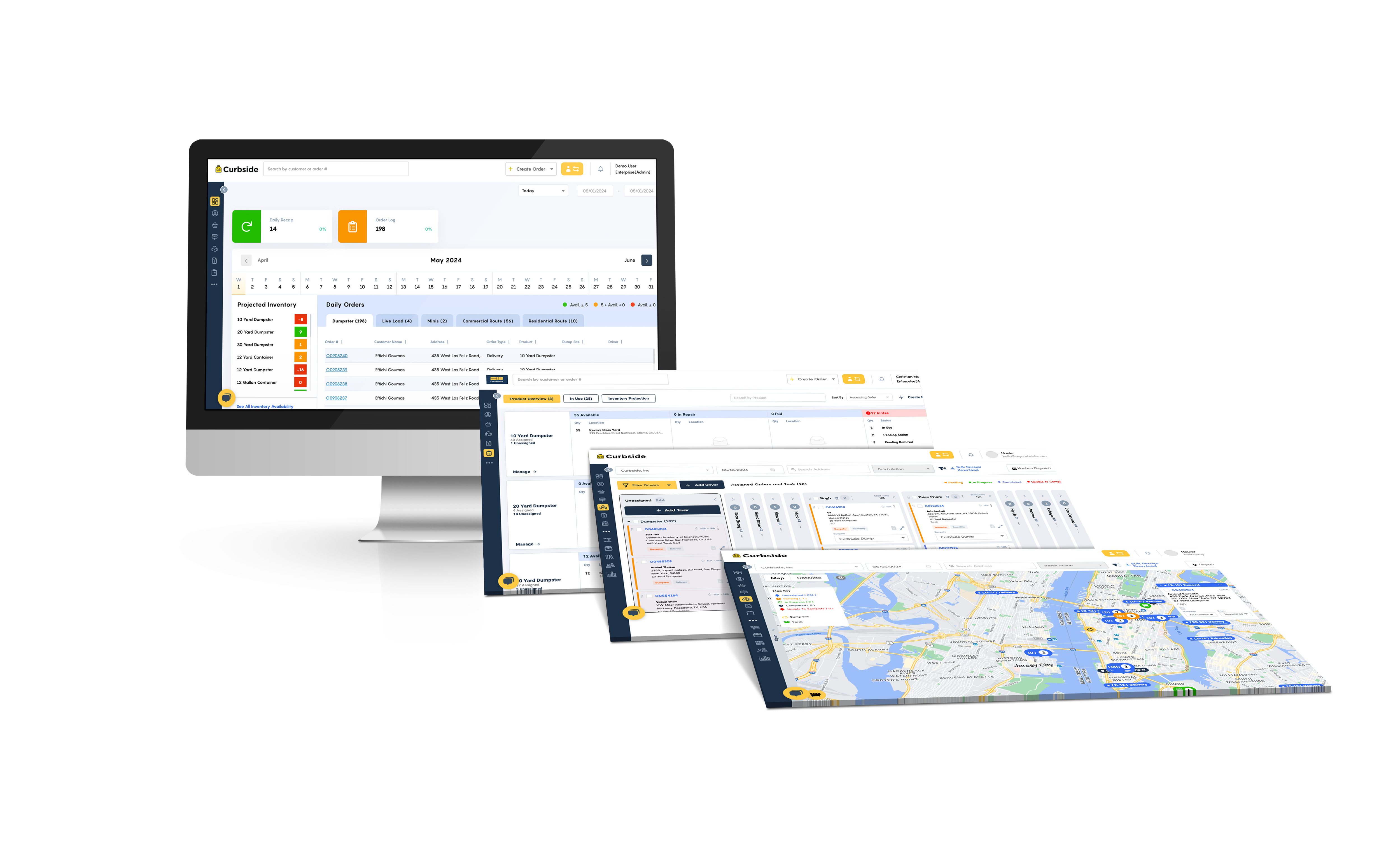
02 The honest bottom line
Five truths that shape everything that follows
Google captures demand that already exists; it doesn't create it. For an urgent, local, considered purchase that intent is worth paying for — but only if you respect these five facts up front.
The money is in two products
Fund Local Services Ads, then Search, in that order. PMax, Demand Gen, Display, YouTube and Smart Campaigns are “later, with guardrails” or an outright trap for a single-market hauler. 🟡 field consensus
Junk gets LSA; dumpster doesn't
Junk removal is an eligible LSA category; pure dumpster rental is not. A junk remover/hybrid leads with LSA. A pure dumpster company has no LSA option and must win on Search + Google Business Profile. ✅
The answered phone, not the click
Most haulers lose 50–80% of the leads they already paid for in the gap between “lead submitted” and “a human responds.” Responding in under five minutes is the highest-ROI lever in this guide. 🟡
Cost-per-booked-job, always
Never judge on clicks, impressions, or CPL. Close rate, not CPC, is what kills or saves the math — a 50% → 30% close nearly doubles your cost-per-booked-job. ✅
03 The channel map
What to run, and in what order
Google is a menu, and most of the menu is wrong for you. Fund it top-down — add a layer only once the one above it is profitable and saturated.
Local Services Ads — your first dollar ✅
Pay per lead, not per click. Sits at the very top of the page with a Google Verified badge. The highest-ROI paid channel for junk removers & hybrids. Not available for pure dumpster rental.
Standard Search — the controllable workhorse ✅
Full control of keywords, copy, landing pages, negatives and bidding. The only Google paid channel for pure dumpster, and the essential complement to LSA for junk removers. Run a cheap brand campaign plus high-intent non-brand terms.
Remarketing — cheap insurance 🟡
Buyers price-shop 3–4 providers. Follow quote-page visitors and form-abandoners for 7–30 days (converters excluded). Display CPCs run ~$0.66–$1.23 vs $5–$30 on Search. Never run cold “all visitors” Display.
Performance Max — later, with guardrails only ⚠️
Usually a trap until you've earned the right to use it: needs ~$1,500+/mo and 30+ clean conversions, hides where money goes, and quietly bills you for brand demand you already owned (reported 10–15%, up to 42% 🟡). Only add it after LSA + Search are profitable — with brand exclusions + account-level negatives + a down-funnel goal locked first.
AI Max for Search — a toggle to test, not a strategy ✅
A feature suite inside a Search campaign. Test only on a mature campaign with tight negatives, final-URL expansion off, and search-term visibility on. Without a leash it spends on “free junk pickup” queries.
04 The LSA asymmetry
The one fact that decides your whole strategy
Junk removal — LSA eligible
“Junk removal services” is a supported LSA category in the US (listed alongside Moving and House Cleaning). Junk removers get the Google Verified treatment and top-of-page, exclusive, pay-per-lead placement.
Strategy → lead with LSA, use Search to scale beyond LSA's lead ceiling.
Pure dumpster rental — NOT eligible
There is no “dumpster,” “roll-off,” or “waste container” LSA category. A pure dumpster-rental company cannot run LSA and must rely on Search + GBP/SEO. A hybrid runs LSA under junk removal and routes dumpster demand through Search.
Strategy → Search first, Google Business Profile / local SEO as the cheap long-run foundation.
What changed in 2025–2026 (re-verify before you pitch)
Google Verified replaced Google Guaranteed ✅
Effective Oct 20, 2025, Google merged the badges into one blue “Google Verified” mark. The catch: the old customer money-back guarantee (up to $2,000) was discontinued. If your pitch still says “Google refunds the customer,” update it.
Cost & the booked-job math 🟡
Junk LSA cost-per-lead runs ~$30–$65, close 60–70% for fast responders → ~$45–$110 per booked job — the best cost/quality combo of any paid channel. Start on Max Per Lead, graduate to Maximize Leads (~10 leads/week).
Ranking — reviews & responsiveness 🟡
Rank = bid × lead-conversion likelihood × rotation. Reviews are the dominant lever (aim ≥4.7–4.8★), responsiveness was elevated to a primary factor in Oct 2025 (missed calls hurt rank), and proximity was downgraded ~April 2025 (good for wide-area haulers).
The credit process got worse ✅
Manual disputes are dead. Bad leads are auto-credited by ML after you “Rate this lead,” but recovery runs only ~15–25%. “Job/geo not serviced” leads are no longer creditable — set service area tightly and assume you keep ~80% of charges.
05 Keywords & buyer moments
Capture every small, high-intent pool
You win by building one themed ad group per buyer moment — each with its own urgency, vernacular, and landing page — not by chasing one big head term (a mid-sized metro may see only 50–300 searches/mo for the core term). 🟡
Dumpster rental — size is the intent signal ✅
Homeowner cleanout / declutter
“dumpster for house cleanout,” “10 yard dumpster rental [city].”
Renovation / gut remodel
“20 yard dumpster,” “dumpster rental for remodel.” The 20-yard is the default homeowner pick.
Roofing tear-off
“roofing dumpster,” “dumpster for shingles.” A 20-yd holds ~3–4 squares.
Concrete / heavy debris
“concrete dumpster,” “dirt dumpster rental.”
Estate / foreclosure cleanout
Plus moving/downsizing & landscaping/yard-waste (10–20 yd).
Storm / emergency
High-urgency, priciest clicks at $15–$28, books within 24–48h. 🟡
Junk removal — the lock is labor-included + speed ✅
Single bulky item
Couch, mattress, fridge: highest volume, lowest ticket.
Estate & hoarding cleanout
High-ticket — fund its own ad group and higher target CPA.
Foreclosure / tenant turnover
Landlord/PM repeat channel; plus move-out & post-construction.
Commercial / recurring — the high-LTV third lane
The defining trigger is contract pain — evergreen auto-renewals, annual escalators, surprise fees. They say “service,” “front-load,” “pickup frequency,” not “rent a dumpster.” A ~$300/mo account = $7,200–$14,400 LTV over 2–4 years 🟡, so it tolerates the highest allowable cost-per-acquisition of the three lanes — fund it accordingly.
06 The big leak problem
For a hauler, wasted spend isn't optimization — it's the whole game
“Dumpster” and “junk” are two of the most polluted words in advertising. You bid into three of the leakiest query spaces in all of paid search at once.
1 · Homonyms / wrong meaning
“dumpster fire,” “dumpster diving,” “junk food,” “junk journal,” “cash for junk cars,” “junk yard,” “junk bonds.”
2 · Jobs & business-opportunity
“junk removal jobs,” “driver salary,” “how to start a dumpster rental business,” “is junk removal profitable,” franchise-buyer queries. They convert at $0.
3 · DIY / free / municipal
U-Haul, the transfer station, the city's bulk pickup: “free bulk pickup,” “landfill hours,” “trailer rental,” “dump run.”
dumpster for sale does not block “dumpsters for sale” or misspellings — add plurals and variants explicitly. This is the #1 reason “I already added that” lists keep leaking.
What to do
- Build account-level negative lists day one (auto-apply across Search + PMax, capped at 1,000 — reserve for universal leaks). Long tail at campaign level.
- Mine the Search Terms report 2–3×/week (new) or weekly (mature). Triage: wrong-meaning → negative; right-intent → promote to keyword; didn't-convert-yet → leave it.
- Run n-gram analysis monthly — see that every query containing “free” or “salary” collectively burned $400 at 0%.
- Turn off silent leaks: Display off on Search, Search Partners off for 30 days, auto-applied recommendations off.
Presence, not “Presence or interest” ✅
The single most expensive setting in the account. The default makes you pay for people merely researching your city from anywhere — a homeowner in Florida reading about Columbus is not your customer.
07 Economics
Cost-per-booked-job, ranked
The durable finding ✅ consistent across independent sources: Referral < SEO < LSA < Search PPC < Thumbtack < Angi. The spread is driven by exclusive vs. shared leads and by close rate. All figures Q2-2026; the ranking is durable.
| Channel | Cost / lead | Close rate | Cost / booked job | Lead model |
|---|---|---|---|---|
| Referral / repeat | $0–$50 | 70–80% | ~$0–$65 | exclusive, warm |
| SEO / Google Business Profile | $5–$15 | 40–60% | ~$10–$35 | exclusive |
| Google LSA | $30–$65 | 60–70% | ~$45–$110 | exclusive, pay-per-lead |
| Google Search PPC | $40–$80 | 30–50% | ~$70–$165 | exclusive |
| Thumbtack | $10–$50 | 15–25% | ~$50–$250 | shared 4–5 pros |
| Angi / HomeAdvisor | $15–$100 (+~$350/yr) | 10–20% | ~$125–$542 | shared 2–4 pros |
08 Seasonality
Demand is strongly seasonal
~65% of residential dumpster rentals fall in spring/summer, with twin peaks around May (spring cleaning) and October (pre-winter), a deep Jan–Feb trough — except a real January declutter bump for junk removal. The curves below are a relative index 🟡; re-baseline against your own call data after one season.
Shift budget month to month
Raise Feb–Jun and Sep–Oct; trim in deep winter or pivot to commercial/storm terms. Don't go dark in winter — cheaper clicks, fewer competitors, real January declutter demand.
Lead the calendar by 3–4 weeks
Planning searches precede booking. Turn the spring cleanout ad group on in late February, the fall yard-waste group in late August.
Pre-build a paused storm group
Toggle it live within hours of a forecast. Use Google's seasonality tool only for sharp, dated spikes (1–7 days) — never the whole busy season, and never double-adjust. ✅
09 Speed-to-lead
The highest-ROI lever in this guide
You are not winning on the ad — you're winning on who picks up the phone first and quotes fastest. Most operators lose 50–80% of paid leads in the gap between “lead submitted” and “human responds,” not in the Google Ads account.
The biggest, cheapest leak is LEAD → CONTACTED.
10 Budget & what to expect
Run the break-even before you spend a dollar
The break-even test — state it verbatim
Google Ads is worth it when cost-per-booked-job < contribution margin per job, AND ≤ your LSA cost-per-booked-job.
Starting budgets 🟡
- Dumpster: $2,400–$8,000/mo
- Junk: $1,500–$6,000/mo
- Or 10–20% of gross revenue
- Budget enough to net ~30 conversions/month — below that you're reading noise. (~$2,250/mo at $75 blended CPL; ~$4,500/mo at $150.)
What to expect on the clock ✅
- 14–21+ day learning ramp; costs above steady-state at first.
- Don't judge before ~30 days / ~30–50 conversions.
- Optimization lands ~week 4; consistent results 60–90 days.
- Baseline ~2:1 ROAS, climbing to 3–5× by 90–120 days for a well-run account. 🟡
Waste management software by haulers, for haulers
CurbWaste was built by industry veterans who understand the difficulties of running a waste business firsthand. Our all-in-one platform handles customer management, dispatch, and billing — so you can focus on what matters: service, speed, and scaling your business.
GET DEMO11 Tracking what actually works
You cannot optimize what you can't measure
In this phone-heavy business the thing you most need to measure — booked jobs from calls — is the thing most haulers never wire up. Without it, every Smart Bidding strategy is blind. The non-negotiables, in order of priority:
Track calls as conversions ✅
Calls are the money action. Use call-from-ad + calls-from-website conversions (count ≥60s), then a call-tracking platform (CallRail, WhatConverts, CTM) with dynamic number insertion tying each call to keyword/campaign.
Track form fills + capture GCLID ✅
One conversion per lead, sensible window, and capture the GCLID on the form so you can reconcile the lead to a booked job later.
Enhanced Conversions for Leads ✅
Hash email/phone at submit, then upload “this lead became a $450 booked job.” This is how Smart Bidding learns to chase leads that book, not leads that just submit.
Offline Conversion Import (OCI) ✅
Import booked-job and revenue events keyed on the GCLID. The only way Google optimizes toward cost-per-booked-job instead of cost-per-form-fill.
Link GA4 ↔ Google Ads — avoid double-counting ✅
Don't import the same conversion via both the GA4 link and the Ads tag. Pick one source of truth per action. Wire Consent Mode v2 / first-party data now.
Ready to get started?
Meet the team to learn more about why CurbWaste waste management software has become the trusted partner for waste hauling businesses nationally.
.svg)

.svg)